Roney wâlâ hoon shahid-e-Karbala kay gham may mayn
Kyâ durrey maqsûd na daingay Sâqi-e-Kauthar mujhey
Dr. Allama Muhammad Iqbal
[English: He hopes and prays that since he sheds tears out of grief for Husyan, Imam Ali would give him all the help he needs.]
About An hour before the sun rise in the ancient Indian city of Varanasi, once home for Lord Shiva and Vedic civilizations of the Gangetic plains, Taiyyab Ali’s family brings forth a special Tazia (or Ta’zïye in Persian which means condolence) in the frontlines of the procession that has historically been led by Bharat Ratna Ustad Bismillah Khan of Varanasi, as the mourners of ‘Ashura procession wait for the call to prayers. Taiyyib Ali’s family have been leading this procession for years now, a procession in which Hindus and Muslims are equally participating to honor Imam Husain, the grandson of Prophet Muhammad (ﷺ)!
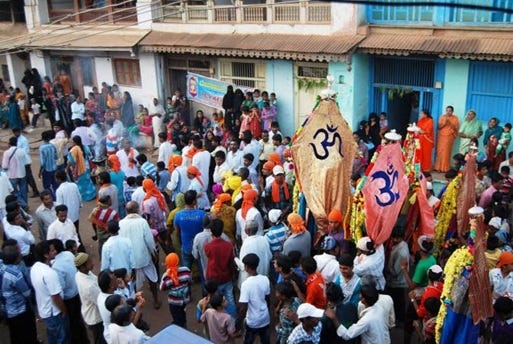
(Hindus lead the procession of Shia Muslims in Varanasi, Bihar India)
This call to prayers is different from the usual or daily five times’ calls to prayers, it even has a special name for it, because it is 10th of Muharram which is the first month of Islamic lunar calendar. It is called Azaan e Ali Akbar, the call of Ali Akbar. Ali Akbar was the elder son of Prophet’s grandson Imam Husain (as), one of the 72 martyrs of the Battle of Karbala including Imam Husain (as) himself in 61 AH (October 10, 680 AD). All men, except one, from the progeny of the Prophet were martyred single handedly in this battle of Karbala. A thirteen years old daughter of Imam Husain (as) is also said to have died immediately after the battle during the journey when female members of the 72 martyrs were brought to Syria, to the court of imprecated caliph Yazid ibn e Mu’awiyyah.

(Sunni Muslims partake in mourning rituals, Poona — Maharashtra India)
Ta’zïye and Shabih (“replica”) is the replica that embodies the sacredness of anything associated with the event of Karbala: be it the fidelity of the horse of Imam Husain, flag of Imam Husain’s flag bearer and brother Hazrat Abbas, henna of Ali Akbar’s fiancé who could never marry, sleeping bed of Imam Husain’s six months old son and a martyr of Karbala.
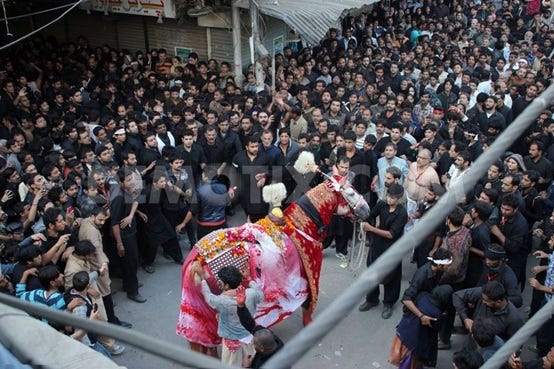
(Shabih: replica of Imam Husain’s horse signifies zeitgeist of Karbala for Shia Musims — Nisar Haveli Lahore, Pakistan)
Religion is a sacred connection between God and man, and sacrifice is what makes relationships secret. If this ‘sacré’ is achieved through sacrifice for God, then Imam Husain is the apotheosis of sacredness, thus known as the ultimate realization of Prophet Ibrahim’s sacrifice. Ismael was replaced with a goat but Prophet Muhammad’s (ﷺ) entire progeny, except one man and a few women, was brutally martyred in the barren land of Karbala where they remained thirsty for three days. Drinking water of Euphrates was banned for Imam Husain (as) and his small caravan of 72 for three days until they were all martyred by execrated caliph Yazid ibn e Mu’awiyyah.
Musa o Firaun-o-Shabbir or Yazid
In do quwwât az Hayât âmad padid
(Virtue and vice, Right and wrong. Musa (Moses) rose against Firaun (Pharoah) and Shabbir (Imam Husayn) rose against Yazid) Dr. Allama Muhammad Iqbal
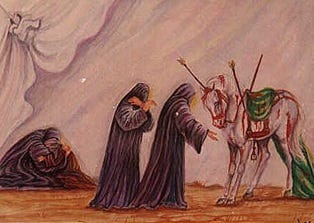
(Imam Husain (as) is said to have led a caravan of only 72 in battle of Karbala against Yazid)
The purpose of Imam Husain (as)’s sacrifice, according to popular beliefs and scholarly traditions of Islam, was not to expunge the sins of Muslim Ummah but to save Islam from a barbaric rule that could have completely adulterated Muslims’ consciousness, resulting in a total expedition of the religion of Islam from the face of the earth.
Gharib-o-sâda-o-rangi’n hay dâstân-e-Haram
Nihâyat iski Husayn ibtida hay Ismâil

(Azadaari at the mausoleum of Imam Husain (as) in Karbala, Iraq)
It was this land of ‘Mesopotamia’ between the two rivers Dijla (not Dajla) and Furāt — the Tigris and the Euphrates where the battle of Karbala forever changed Muslim consciousness engendering brimful of cultural yields like so many stars that rise along the edge of a burning piece of paper as it is consumed by the flame! Had it not been for the mellifluous poetic genres of the event of Karbala, Urdu language would have been deprived of rich literary works of marsiya, nauha, and salam. If it was not for Shia rites and rituals of mourning, the Indo Persian civilizations would not have experienced per formative innovations such as soz-khvani, and the art of declamation and eloquent oratory embodied in the tradition of zikr. Iran would not have developed its dramatic performances ta‘ziye tradition. This same ta‘ziyetradition takes architectural forms in south Asia (Haq, 2015), all of these have sprung from the roots of Karbala event.
Qâfilây Hijaz may ek Husayn bhi nahin
Garche hai tâbdâr abhi wâdi ey Dajlao Furât
(English: The land of Tigres and Eupharates called some staunch devotee of Islam who could relieve them of their serfdom. Iqbal only wished a man, a follower of Imam Husayn might come up to help the Muslims of Iraq! Dr. Allama Muhammad Iqbal)
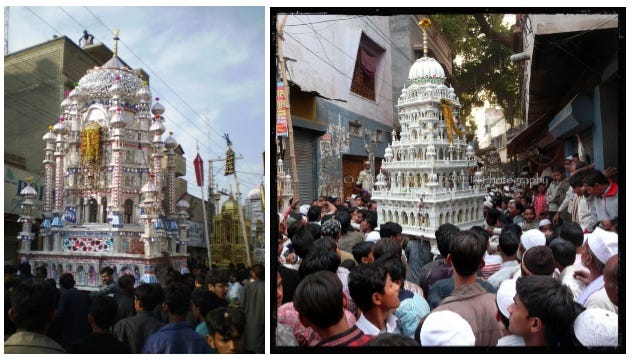
(From left to right: Ta’zïye in Khairpur, Sindh Pakistan and Varanasi, Bihar India)
Karbala, hence is a narration of Imam Husain’s (as) sacrifice that forever saved the sacré of Islam. This is why Karbala does not merely remain a historical event, rather it takes a metaphysical form. Azadaari, Azadaari, an Urdu term which literally denotes mourning rites commemorating martyrdom of Imam Husain (as), henceforth becomes a metaphor for the event of Karbala. Imam Husain (as) is a metaphor, a title for which every Muslim strives as Prophet Muhammad (ﷺ) once said: “each one of you is Husain and every land is Karbala.” Azadaari symbolizes the remembrance of Imam Husain’s (as) sacrifice and teaches the lessons about the life of Imam Husain (as). Azadaari is for and about the love and passion.
Sidq-e-Khalil Bhi hay ishqe sabr-e-Husayn bhi hay ishq
Mârika-e-wujud maiyn Badr-o-Hunayn bhi hay ishq
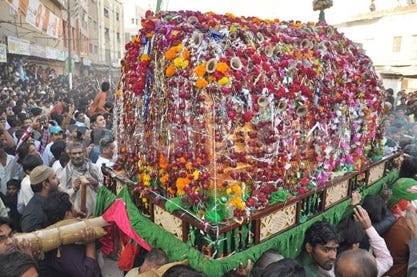
(Ta’zïye: the sleeping bed of Imam Husain’s six months old son who was martyred in Karbala)
Haqiqat-e-abadi hay maqâm-e-Shabbiri
Badaltay rahay hain andâze Kufio-Shâmi